Showing posts with label Black History Month. Show all posts

Thursday, February 2, 2017

The Food Empowerment App For Your Chocolate Needs

This free app is a grocery store treasure, making shopping for cruelty free, slave free chocolate easy as pie.
The resourceful Food Empowerment App is a handy guide that allows grocery shoppers to find ethical chocolate while perusing the aisle at the same time. Great features include looking at the list in three different modes-- the recommended list, the not recommended list, and all brands. Plus, it's rather nice to read up on the FEP philosophy and how the brands are given ample amount of response time before generating to respective place on each list.
People need to know where their chocolate comes from. I cannot stress this enough.
I strongly enforce during Black History Month that all black lives are important on this very earth we stand on. As our cultural landscape worsens due to monsters in office, we have to be strong and resilient together more than ever before. One primary goal is to make sure that we support companies that disclose information about where their cacao beans are sourced from. Child labor and slavery is wide and rampant throughout Western Africa. I've read stories from children who work day till night, receiving less than penny earnings (sometimes not even being paid on time). Their backs often are injured. They are harshly punished. They don't see their parents or siblings often enough. The statements go on and on-- each worst than the last.
Lately, it has been an upsetting struggle, watching people discuss value of black lives and attending marches/protests while stuffing a Snickers or a Twix bar in their mouths. How can a person not care about where their chocolate comes or the pain involved in the making of it? I want everyone to understand that this is a global issue, a colossal concern that we must consider respectfully with some form of endearment and compassion. If collectively we hurt Hershey, Mars, Nestle, etc, perhaps they could see the impact and shoot for change. Maybe. Just maybe.
Until then, it's wonderful that a company like FEP has rigorously campaigned and opened eyes to this huge, under looked problem.
Please install the Food Empowerment App. It is free and simple. Plus, a lot of chocolate brands are affordable. They might not be available in the office vending machines, but they are in certain grocery stores like Whole Foods Market, Shop Rite, Kroger, and even CVS and Walgreen's. There is no excuse for continuing to give money to those greedy corporations inflicting violence on innocent brown bodies.

Proud of Daiya for being included here. It's one of my favorite vegan brands after all.
Remember that only the So Delicious organic items are Food Empowerment Project recommended. 
Speaking of Taza.....
Since these were on sale for $1.69 each, I bought all three vegan flavors, thrilled and overjoyed to do my part in purchasing chocolate created from kindness and sustainability. Funnily enough, this chocolate is underneath Salazon and Altar Eco-- these two are also on the recommended list.

Monday, February 29, 2016

Happy 31st (or 124th) Birthday Augusta Savage!

Augusta Savage, a Leap Year baby, was one of the most influential figures in the Harlem Renaissance era.
I found more information on Augusta Savage ever believed possible. The extent of insatiable knowledge still has yet to fulfill craving to learn extent of what can be true satisfaction. A void still sits, waiting.
Schomburg Center research stretched out my lids and sockets. Filled my heart and mind with impressive events making up Augusta's tragic history. Apparently not only are most of Augusta's sculptures housed in the center's distinguished collection, she has kept a scrapbook-- a scrapbook! I cannot wait to see her writings, her rare, candid photographs. To think, all of this time, Google, the brick wall end. It's beyond usual scoping, beyond traditional art history books always filled with missing anecdotes one doesn't realize is needed.
I created an installation that opened today called Augusta Savage's 31st (or 124th Who's Really Counting) Birthday Party and runs to next Wednesday.  It is purely conceptual celebration comprised of typewritten biographical text on drawing paper, Pan-African ribbon colors attached to miniature pale and brown clothespins, and small red balloons.
Wonderfully engaging, gratifying discussions with surprise visitors and fellow friends who bore seeds growing in thought process this afternoon. Thank you to everyone who came and will come inside the party to learn about Augusta Savage, right on this final day of Black History Month and on the eve of Women's History Month.....

It was very quiet vigil as students and faculty ushered into the space, reading lines and blocks of text.
The ribbon at times hid text, making viewers interact if inkling curiosity became too great.
Awed joy upon witnessing individuals move along the timeline, finishing the unfinished narrative.


After two straight years of putting up with my constant writing desires, the borrowed typewriter friend decided to take immediate hiatus right at the tale end of Augusta's life. The plan is to purchase new ink cartridge and write more and more. Augusta's story is far from finished here.
Lift Every Voice and Sing, otherwise known as the National Black Anthem and the bust of James Weldon Johnson, writer of the song written as poetry, inspired Augusta and was in turn inspired by her.
Top 7 Augusta Savage New Discoveries:

1.) Augusta is accepted over 142 other girls at Cooper Union. She completes the four-year program in three years.
2.) She received a Julius Rosenwald Fellowship to study in France for two years and then received a grant by the Carnegie Foundation to travel to Belgium and Germany for an additional eight months.
3.) She studied at The Académie de la Grande Chaumière, showcased at the Salon d'Automne, two Salons, and often received high honorable praises.
4.) She has shown her work alongside Henry Ossawa Tanner and Meta Warrick Fuller twice.
5.) August Rodin, Solon Borglum (Art Academy of Cincinnati alum!), and Charles Despiau (to whom she studied with in France) admired her talent.
6.) Having always had a natural inclination to teach art, she started her own school, Savage School of Arts and Crafts in Harlem, with her own funds. Eventually Carnegie Foundation and WPA aide in her endeavors. She cared a lot about her students, getting them into shows and exhibits, especially abstract painters Norman Lewis and Gwendolyn Knight (soon-to-be Jacob Lawrence's wife), and incredible draftsman, Ernest Crichlow.
7.) She is the first black woman to be elected in the National Association of Women Painters and Sculptors.

What an amazing human, an excellent artist and a profoundly progressive spirit!
Augusta Savage is the definition of a true heroine. Gone but never ever forgotten. 

Friday, February 26, 2016

Fabricated Fantasy Romanticism Shadowed By Disturbing Historical Trauma

Experimenting with remarkable deception and manipulating history is part of Fabiola Jean-Louis's cultivated master plan.
At Harlem School for the Arts, Fabiola Jean-Louis's Rewriting History: paper gowns and photographs is a breathtaking, suspenseful portrait survey. Surreal concept of Black Girl Magic poignantly address the artist's multifaceted heritage rooted in Afro-Carribean ancestry and puts past, present, and future on notice. Tongue in cheek with severe lashings in pretty bold packaging, rectangular gold frames contain impressive digitized prints that mirror hyper realistic historical paintings. Elaborately staged settings entail dark and moody environments. Palettes are as dramatic as noteworthy Romanticist/Rococo era painters Thomas Gainsborough and Élisabeth Vigée Le Brun. There are no regal Marie Antoinettes or noble Queen Victorias implanted here. With curly coifs, braided updos, and pearled locs, women of color are dressed in fetching period costume, presented as beautiful, desirable ladies as important as positioned objects in their possession. Some images purposely interlace grisly accounts with interior frames and lieu of adorned flowers to lessen the merciless blow.

Madame Beauvoir's Painting, 24" x 31," archival pigment print, 2016.
Jean-Louis confronts the birth of white supremacy language, discloses the challenges and stigmas of colorism, and the centuries-long psychological damage of racial discrimination.
Madame Beavoir's Painting, masked in a heavy arsenal of froufrou fashion, initiates unsettling dialogue, obscuring idyllic fantasy and blatant reality in shocking orchestration. A woman draped in rich crinkled fabric and opulent jewelry stands before a framed image of a violently whipped figure, red particles deliberately splattered in small, intended doses. It is that of a slave. Slavery, though abolished in 1865, still remains an integral part of history, a bruise that can never be faded blemish. This beaten figure could have been this woman's ancestor, a great great great relative forever immortalized as indentured servant, as scientific beastly analysis.

Carrie Mae Weems altered version a similar archive photograph version in her From Here I Saw What Happened and I Cried series. Chromogenic color print with sand-blasted text on glass.
 Madame Leroy, Conquistador, and Madame Beauvoir's Painting grace the walls with layered visual meaning.
Jean-Louis's unique portraiture-- truly provocative surrealism in advanced photography-- embarks on vulnerable paths impossible to bear away- both physically and emotionally. Artificial gold gilded frames and fanciful distinguished costumes are plot devices meant to allow viewer to become suckered in, become enthralled in materialistic grandness of ostentatious spectacle only to be delivered abrasive punch.
For example, Madame Leroy is a theatrical vision. Gloomy background enhances radiance of her skin, of her gold gown and its whispering rustles and bustles, and glint of luxurious jewels at her ear, wrist, and chest. She stares out into the viewer's vicinity, languidly fixated while poised in demurely classic gesture, her elegantly high box braided coiffure nearly reaching top of picture plane.

Madame Leroy, 24" x 31," archival pigment print, 2016.
Violin of the Dead, 22" x 29," archival pigment print, 2016.
The Color Purple, 22" x 29," archival pigment print, 2016.
Rest in Piece, 22" x 29," archival pigment print, 2016.
Rest in Piece goes beyond being diagnosed as a close up shot. This zooming exemplary portrait of Madame Leroy's dress, playing on painterly trompe l'oeil illusion tactics, amplifies old horrors stemming from ugly racism still refusing to die. Among threaded bead work and torn text bodice repeating words "historical," "Europe," and "geography," nestled inside ornate silver frame, propped against serene blue sky, hanging on a tree with budded pink rosebuds is a lynched figure with RIP grave nearby nestled in a thicket of wiry ground. It tells our tale well. To be taken under false sheltering wings of Eurocentric aesthetics yet not forgetting place of the brown body in the extent of Eurocentric gaze defines Rest in Piece's representation, the core of its meaning.
In black history, despite evidence of aggravated murder and malice, the mental and physical harm of the brown body, the gauntlet is rarely thrown. Lost victims and the grieving family of those victims are guaranteed no belief in a system that was never designed to protect them.
There serves no justice, no peace. Only piece. And that piece is knowledge of being wronged.

Coffee Dress, newsprint w/coffee stain, 5" x 7," 2015 in front of Passing, 40" x 60," archival pigment print, 2016.
Each paper costume that these magnificent characters have worn are displayed. Unbelievably layered craftsmanship, sewn with commendable skill and extreme dedication to detail, genuinely mimic fabrics down its thin, wispy mannerisms. To wear paper, a delicate, fragile thing that one can write narrative, is a deeply embedded metaphor, an allegorical context of the entire exhibit.

Louis iii, 4" x 5," pattern paper painted with acrylic, 2015 (bottom).
Jean-Louis's must experience, altering turbulent makeup of not-so-ancient history, has been extended to April 1, 2016. Please go if able.

Tuesday, February 16, 2016

By The Atomic 29 Tipped Arrow of Cupid: The Art of Mario Moore

Together, 54" x 69," oil on canvas, 2015.
Love is pure, sacrificial, untouchable, fragile.
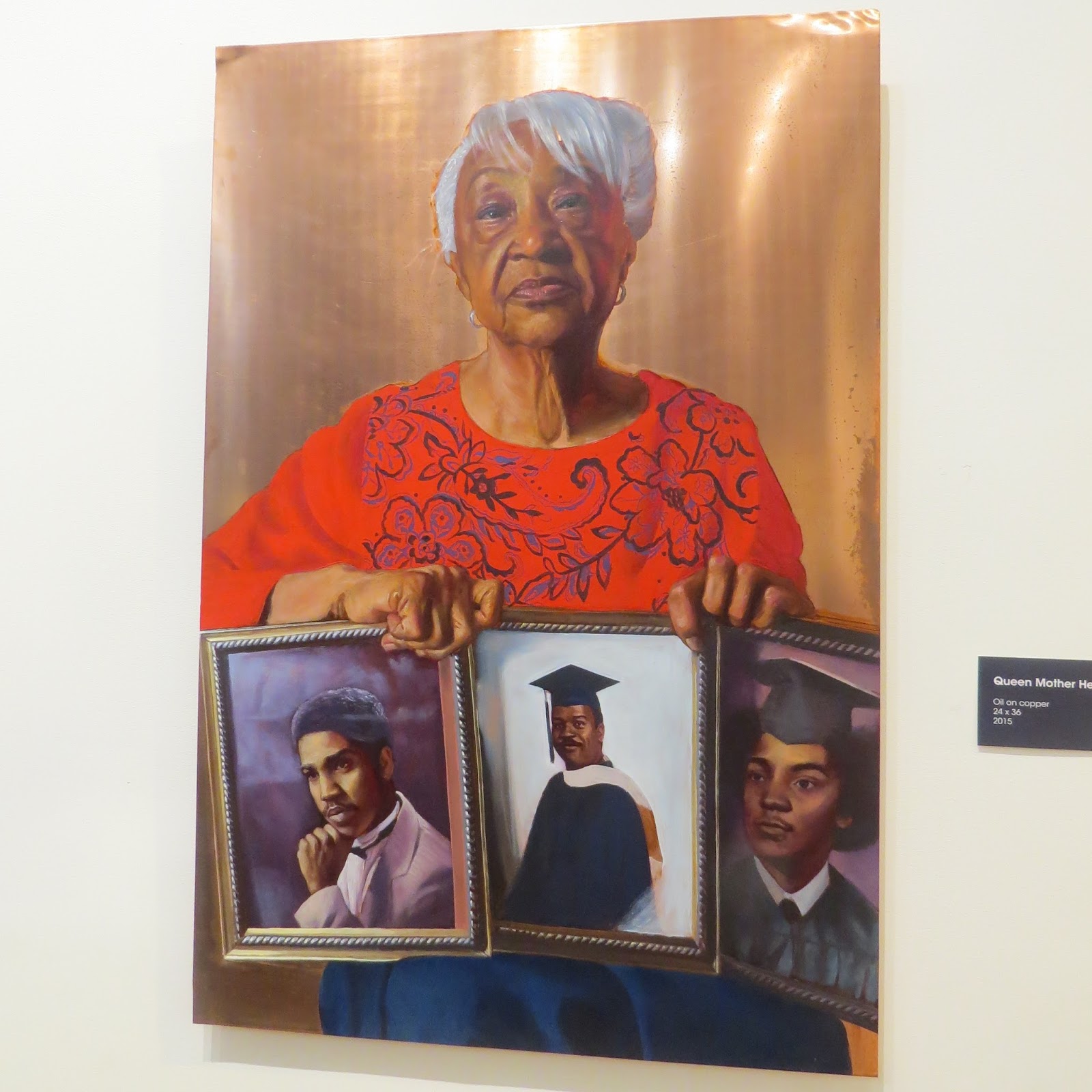
Mario Moore's "Refracted Light" had pulled back gossamer curtains, unveiling a past standing vibrantly on familial foundation of love. Moore captures fruitful upbringing in mesmerizing detail. Each harmonizing brushstroke shares angst-driven, soul-stirring, heart-throbbing, undeniable compassion filtered through enchanted realism. Rapt attention draws focal concentration to traditional academic techniques holding hands with postmodern issues facing black bodies today. By painting powerful portraits on copper, atomic number 29 otherwise symbolized as Cu, places marginalization on a mighty scintillating pedestal.

Together close up.
In a prejudiced society so quick to illustrate black people as violent individuals especially those murdered out of racism, Moore's compositions showcase convincing opposition, the realistic positives in a harrowing narrative relying on stout dignity and ethereal poignancy. This compelling maneuver divulges humanistic layering, rendering figures in a deliberately sympathetic nature. Riveting physical urgency in Together drives a sense of emotional strength and unwavering grace. The clutching embrace between man and woman in front of a mirror is evocative, suspenseful. Narrative within narrative entails a close intimate bond yet opens up an unmasked sorrow coyly hinted in the woman's dewy eyes.

Study of a Growing Seed, 10" x 10," oil on panel, 2015.
Study of a Growing Seed, Study of a Grip, and Love reflect on different stages of life's memories, allowing storytelling hands to relay present time with framed photographs that had documented important historical events-- birth, high school dance (perhaps Prom or Homecoming), and romance. 

Study of a Grip, 12" x 12," oil on panel, 2015.

Love, 10" x 10," oil on panel, 2015.
Queen Mother Helen Moore,  24" x 36," oil on copper, 2015.
Refracted means to make a ray of light change direction when entering different angle.
Four women bring the exhibit its endearing name. To place them on metallic surfaces enriches their valuable importance. From their hairstyles, to their facial features, to their strong fingertips, each woman is individually distinguished, each manner specifically defined. Three women hold photographs of men in their hands-- some are larger parts escaping from other paintings, forming an interesting repetitive dialogue. Queen Mother Helen Moore holds two black men graduating and the prom/high school photograph from Study of a Grip. Whereas Yeah G Ma Don't Play is a larger role than that of Love.
Herstory, however, is a portrait leaving behind smallest amount of copper background. The woman doesn't hold photographs. Instead, she has an arm crossing her chest and a defiant hand on her cheek. Eyes house sassy attitude and upturned mouth carries wry amusement. A note beside her figure asks, "fear courses through the blood of ignorance but who gives us salvation through hope?"

Yeah G Ma Don't Play, 24" x 36," oil on copper, 2015.
Herstory, 34" x 28," oil on copper, 2015.
"Fear courses through the blood of ignorance but who gives us salvation through hope?"
Mom Says I'm Her Sun, 36" x 60," oil on copper, 2015.
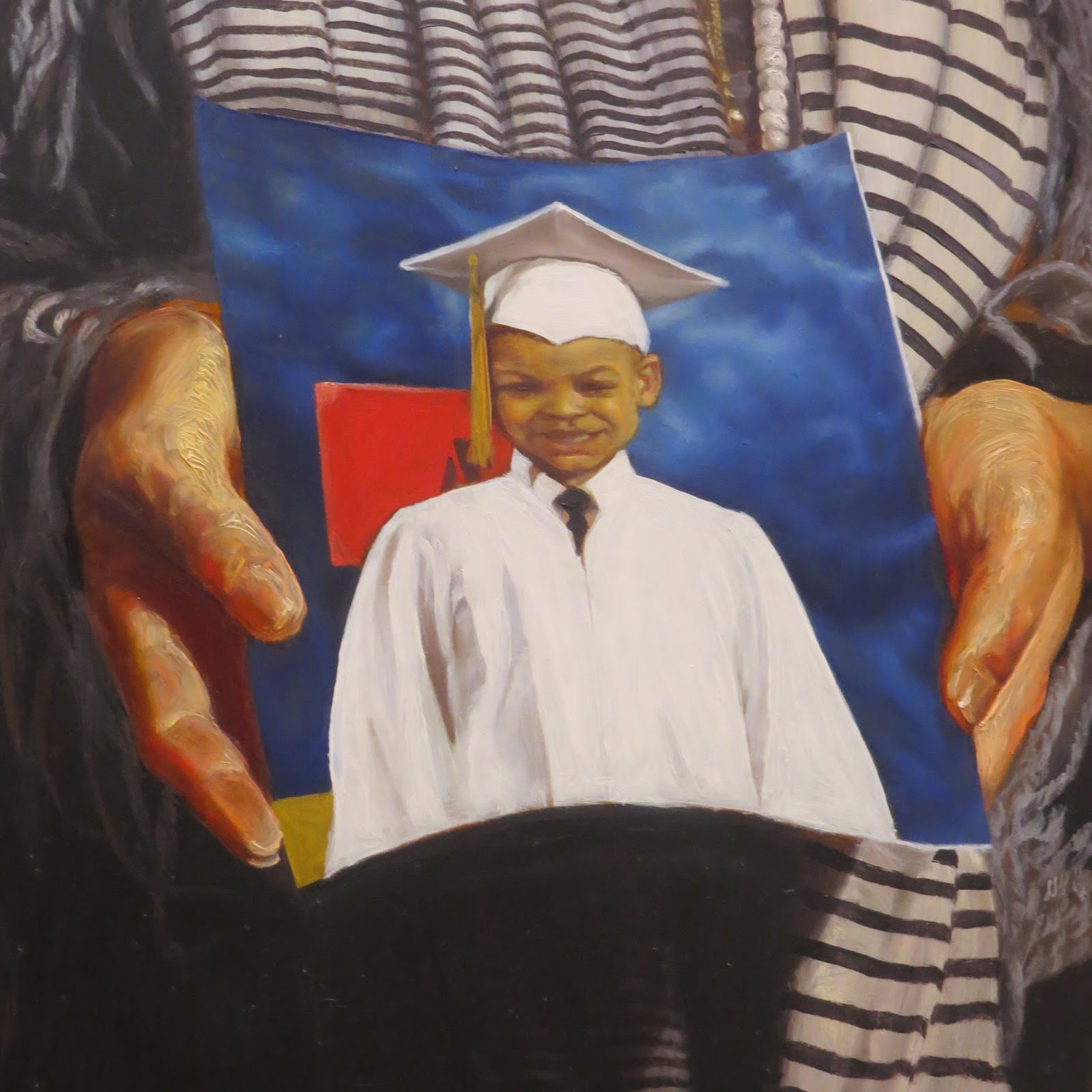
Mom Says I'm Her Sun is a wonderfully composed painting demonstrating the artist's sophisticated ability of having copper background offset golden highlighted planes of his mother's three-dimensionally carved face. Like James Abbot Whistler, Henry Ossawa Tanner, and others before him, Moore depicted maternity in a rather dignified way. Moore's female parent is cast in pensive radiance, staring directly into viewer's soul, holding picture of a graduating young child with pride, with a seeming means to offer him, offer him up to the world where all glitters are not gold, or in this special case-- copper. From dedicated commitment to making her fabrics appear soft and touchable to the warmth of her subdue face, this beautifully crafted art was the truest star, the guiding light of the whole exhibit.

Mom Says I'm Her Sun close up I.
Mom Says I'm Her Sun close up II.
Mom Says I'm Her Sun close up III.
Moore's tenderly heartfelt exhibit is gone now from miniscule stage/ gallery space of Harlem School for the Arts. Gratifying presence lingers in mind and spirit, surging forth vibrant images dismantling pigeonholed stereotypes. Perhaps the black women depicted are single mothers honored to have had handsome, educated sons.  Or maybe they are holding onto their child's youth, pining away for the days of old, when they could protect their boys from society's perceptual evil. Either way, Moore most importantly conveys love, the kind of love provided in the cusp of a strong, vital family. It's the kind of love inherited, a genuine love that cannot be triggered by fictional arrows.
And love inherently ties these beautifully expressive works together.

Thursday, February 4, 2016

Highlights of Schomburg Center's Hosted "Basquiat and Contemporary Queer Art" Conversation

Dr. David Clinton Wills, Kimberly Drew, Juliana Huxtable, Andre Singleton, and Dr. Jordana Saggese led an enlightening discussion on contributions Jean-Michel Basquiat brought into the art world and how he continues to relate to the now.
On Monday evening, I visited the Schomburg Center for the second time in my life to see the "Basquiat and Contemporary Queer Talk." Curated by Basquiat Still Fly @ 55 founders Ja'nell Ajane and Ayanna Legros and held in the Langston Hughes Auditorium, the remarkable panelists were Black Contemporary Art's Kimberly Drew, artist/deejay/poet Juliana Huxtable (star of the New Museum Triennial), author Dr. Jordana Saggese, Very Black's Andre Singleton, and Dr. David Clinton Wills.
Its purpose was to discuss Basquiat in this imperial present, placing his amazing, powerful, distinctive work into black body intersections, black body perception. Stimulating dialogue spoke on Basquiat's progressive influence on queer thinkers and art/sociology theorists, bridging narrative between complex minds and visual language.
"There was potential for conflating, room for vibrance, dynamism, queerness, resolution, blackness, and death-- celebration, ritual."
The panel analyzed Basquiat in different angles. Semantics and racial identity politics addressed his heritage as Haitian and Puerto Rican, his multi-disciplinary interests, his fluency in English, Spanish, and French, his use of African words and ancestry, historical negativity. Each sharp shooting response activated my resurgent love for the tragic painter, an intelligent man whose methodical practice and heavy hitting dialect came and exited my life at varied intervals.
This conversation made me utterly realize that he can never be a fleeing force ever again.
Basquiat is here to stay. His body may no longer spray paint sophisticated prose on random buildings or cross out grouped linguistics on torn cardboard scraps with thickly applied Oil Bar sticks, his work remains active and alive. Generation after generation continues to find something resonating about Basquiat-- whether it be his paintings, his drawings, his writings, his fashion statements, his intelligence, his attractiveness.
Of Basquiat, their instructor had said, "he broke boxes, broke chains, and broke constrains." She also said that one of the best aspects of teaching was to inspire and support students and that it was wonderful to include Basquiat in the contemporary scope. She introduced her students with beaming pride. Ayanna Legros (left) and Ja'nell Ajani (right) founders and curators of Basquiat Still Fly @ 55 giving thanks to all those that made this special event possible.
After opening up with Dr. Clinton Wills reading Langston Hughes' famous poem, "Genius Child" and a sincerely respectful moment of silence, the panelists discuss what led them to pay close attention to Basquiat and the frank messages his work provoked.
"I discovered him through Julian Schnabel's film. I thought the story fascinating. Basquiat redefined painting, invented a newer perception, threatened to eclipse his contribution to art, establish awareness of his place, wasn't ignorant and still very significant today."- Singleton
"I was aesthetically drawn to this cool, weird art kid, his unapologetic fashion shaped my college art history."- Huxtable 
"Basquiat had an access to an idea, championed a certain kind of cannon, eventually realizing few black artists operating on prolific, avante garde mannerism. He set model for questions, sense of experimentation from art, music, dynamic, [incorporating] difficult language, text and imagery, colonialism with strong disgust and frustration, [displaying] sensibility and rare visibility."- Saggese
"First day I encountered Basquiat, [seeing] violence on modern art. I contested with him, but he was there first, a genius. I had denied him. He had a sense of "black love," productivity of human body, history interpretation, crafted beautiful dynamism, oppress expression, context of being unafraid of your own power, your own creativity and tenderness."- Drew
" [There] was constant negotiation in him establishing his own pantheon. He gives figures currency by putting them on coins, taking things from text books, art museums, multi lingual. Like Romare Beardon and Bob Thompson, inserting self in broader context."- Saggese
One of the panelists said, "he made a space for us to sit." They couldn't have any more correct. A few more highlights, I captured here.
They articulately spoke of Basquiat's legacy softened by the impact of post modern core-- commericalism. He negotiated race and blackness in the art expression, the effortless importance of recognition. He had been so successful, a savvy businessman very aware of his power, his position.

"He was the first DIY [artist] on MTV and GQ, taking up responsibility as a scholar before art history could catch up, to go vital without agency, tripped of name ownership, mediate proximity, a name that once was a life."

After the engaging conversation ended, mesmerizing to the brink of my stimulated brain, I left the Langston Hughes Auditorium and took a moment to stand in awe at his interment. Underneath maroon circle with turquoise outline and schematic lightning bolt cracks, lies a cosmogram medallion, his remains. I shut out the gathering crowd, feeling his eloquent poetry invade and sink right into my pores-- right on his 113th birthday.  I couldn't believe fated luck.
It was a needed experience. The sustenance granted a sated soulful fullness.
"Tenderness and authentic are not weak emotions."- Saggese
Visionary voices of Langston and Jean-Michel, two vulnerable, brilliant humans, shared the cerebral cortex of my mental stage. whispering to continue onward as both artist and writer.
And I simply cannot refuse.

Tuesday, February 2, 2016

For a Long Lost Sister Born Aquarian

Taken in a bathroom after my sister's first runway show.
I have two siblings borne in Black History Month-- a younger brother and a little sister.
My sister's birthday is today. My brother's birthday was yesterday. I spoke to him. As for my sister, I haven't seen or heard from her in six years. No one in the family has.
Six years is a long time to have lost one's original best friend. We had shared hopes and dreams, desires of living out of a difficult circumstance that promised the worst endings for two black girls. We weren't always close knit. We didn't always stick together like glue. Sometimes we fought and challenged and stole from each other.
In good times, we enjoyed our multi-colored Barbie arrangement and spoke way past bedtime with Ma walking past our shared bedroom shouting, "hush!" and "go to bed!" We bonded over Buffy the Vampire Slayer. Mighty Morphin Power Rangers was ours. She was Trini the yellow ranger and I was Kimberly the pink one with a skirt. She hated soap operas, but we could talk about "Passions" for hours. 
I remember my sister as a fighter, a courageous, vibrant soul who spoke her mind and challenged anyone contesting against her values. She could tell wonderful stories, rap hardcore verses, sing metaphoric poetry, and draw a great set of hands. Today, my mom has her beautiful collage portrait of Halle Berry hanging in the kitchen.

My sister was in a special program and one of the rewards offered her congratulatory monies. She wanted to include me. So she used her congratulatory monies on a trip to Columbus, Ohio. We hopped on a Greyhound bus and she chastised me for rudely reading Harry Potter and the Half Blood Prince the entire ride. We attended a concert featuring Bow Wow, Omarion, B2K, Marques Houston, and more. I didn't necessarily like the musicians, but I did love spending time with her. We stayed overnight at a modest motel. It was an amazing gift shared and experienced. So much splendid fun.
I was awed by her beauty and tall height. Everyone adored her. It was only natural that she would begin modeling years after graduating from high school. She moved to Chicago to build a portfolio and shared most on Facebook or the short lived myspace. Often, she would send amazing care packages and come home for Christmas. I still love the glow-in-the-dark celestial bedroom curtains she had gifted. And they still glow. Like her.

My favorite glamour girl.
Still, even when we were miles apart, she sent emails and amazing care packages. She would talk about harmful environmentalism, send movie codes, talk about her travels, encounters at random hostels, and the fear of having Marfan's syndrome.

One of many shots taken in our tenure. She was teaching me how to bike in a mild rain sprinkle and caught this whimsical rainbow.
We last spent time together in Denver, Colorado, summer of 2010, sharing our hair in the same style-- long length box braids. I had been house and cat sitting for a friend studying in Paris and invited my San Francisco California living sister for a week. We played cards and board games, frequented night clubs, borrowed each other's clothes, rubbed cat bellies, gushed over Janelle Monae and Tegan and Sarah, and bedazzled the local park at night like carefree vampire girls. At the time, she was a year into veganism. She tried to ease me away from my daily consumption of cheese, eggs, and ice cream. I foolishly paid her no mind. Now, I often wished to not have been so stubborn back then.
I heard my sister. I just didn't listen.
Unfortunately, a roll ignited and we ended on uneasy terms. On the morning, after a goodbye hug, she left my friend's house. I felt sadness and regret, especially upon discovering a sweet card she left behind, striking a poignant inner cord. No matter how hurt or angry, a sister's love is a love that is so special that such animosities float away.
We called and texted. Slowly, she drifted towards an unreachable place, deleting all of her social media accounts and email address, disconnecting phone.
I miss her. I miss her a lot.
It's been so hard and brutal without her presence. I yearn to talk to her about hair. About veganism. She doesn't even know that I became a vegan.
Yet there's so much I don't know about her either. Like where she is.
It's a frightening thing not to know. The not knowing eats away at sanity.  
Every once in a while, I read one for her emails and fall into solace. She was a Jane of all Trades.
I must reflect on an eerie excerpt from my sister's piece called, "Alice's Sister," from March 13, 2009 (my paternal grandmother's birthday), a supernatural mystery story about an only child borne into privileged superficiality, longing for a sibling. She had wanted to know my thoughts. I thought she was onto something very suspenseful.

"I can show you how I did it, I can teach you how." I heard the smile in her hollow voice.
She knew the last thing I wanted to know was how she did it. I didn't want anything to do with her or the secrets she bought with her.
I couldn't speak. All I could do was shake my head no.
The sound of her approaching footsteps stopped a few feet from me. I stopped shaking for a moment. A gust of air blew past me.
I suddenly felt her skeleton hand on my shoulder.
I nearly jumped out of my skin.
"What are you!" the words came out of me with repulsion.
"I'm your sister Alice."
I shook my head too afraid to verbally challenge her.
"Yes I am." she said with a chuckle.
Tears began to roll madly. Why did this thing choose me to come after?! To torture me for wanting a sister?
"LOOK AT ME!"
As I shook my head no, my vision began to blur with darkness and my neck began to pop.
I knew she was entering me, forcing me to look her direction through mind control.
I tried to fight her. It was like falling in and out of a sleep that became too easy to resist.
"I can't," I cried weakly, hating myself for not having the strength to fight against her.
But of course she had her way. I was turning in my chair fully in her direction. I felt my eyes still tightly closed beginning to pull apart.
I blacked out for a second..... 

Monday, February 1, 2016

Full Fledged Nappy Loving Zora Girl Embracing Blackness

Power to the marginalized lady. Nappy Dictionary t-shirt, $25, globalcouture,net
Happy February!
It's the first day of our month, a rather short embittered month that fortunately receives a "leap-ing" bonus day-- an Augusta Savage birthday to be exact. Yet we people of African descent celebrate our culture beyond the scope of Aquarius and Pisces zodiac signs. Ancestral blood doesn't take a quiet slumber on the other 300+ days of the year. One cannot begin to squeeze in what African Diaspora has accomplished in twenty-nine days anyway.
This reflection leads me to searching inside of my mindset.
There was once a time I wasn't proud of the skin I was born in.
I love myself more than I ever had. Originally, I was ashamed of my awkwardness, my short, nappy hair, and the gap between my teeth. When I went vegan, I gradually gained more weight in the last two years, reaching personal high. From television to magazine displays to films, I didn't feel beauty within. I felt grossly unattractive in spite of my artistic talents and burgeoning writing culpability. Plus I spent so much time lazily watching daytime soap operas, obsessing over Downton Abbey, and reading Jane Austen, the Bronte sisters, Sylvia Plath, and white historical romance. I studied every European painter/draftsman master under the sun with Ingres being a huge favorite.

"Those that don't got it, can't show it. Those that got it, can't hide it."- Zora Neale Hurston, $25 100% cotton t-shirt, globalcouture.net
At fifteen-years-old, Wallace Thurman's "Blacker the Berry" changed my world. The plight of Emma Lou Morgan is a plight many of us know well. It's deeply ingrained, ironed and pressed in young impressionable heads, that darker skinned women are not beautiful or only beautiful if features are European, bodies thinner, attitudes less sassy.
I'm older and scratching the wisdom surface. I am smart, humorous, a firecracker. I respect what Hair Wash Day means. I treasure every moment picking out my fro. It;s kinky, wildly nappy. I like my purple spectacles, my full lips, and new septum piercing. I can appreciate my body, but it will take a while longer to value stretch marks.I want to be braver, more confident. Less afraid. Be a brazen conqueror.
Yes, I love reading Plath, Virginia Woolf, those contemporary writers who love historical romance fiction, the popular we-always-have-to-read-him-male writers. I enjoy Downton Abbey with tea.
However, it's applauding Issa Rae's Awkward Black Girl web series, rooting for Viola Davis as snappy Annalise Keating on How to Get Away With Murder, having weekend marathons of Girlfriends, and reading Zora that empowers and engages the once closeted doubt in myself. Serena and Venus Williams state incredible words on beauty standards. Janelle Monae often candidly speaks out on injustice. Both Nina Simone and James Baldwin campaign for civil rights through beautiful lyricism. To these, is a real inclusiveness, a real drive to showcase the special gift of being black, of being included, of saying "you're not alone."

Laughing inside and out at the joys of being who I am supposed to be-- painting paintings of Nina Simone handing out Afro picks among other narratives that bring joy to the cluttered, chaotic studio.
Countless individuals have paved the way. My ancestral kings and queens that led me towards a remarkable journey. Literary influences such as Langston Hughes (happy birthday!), Wallace Thurman, Zora Neale Hurston, Phyllis Wheatley, Gwendolyn Brooks, Maya Angelou, Alice Walker, Angela Davis, Chimamnda Ngozi Adichie, Toni Morrison, and visual geniuses Augusta Savage, Jean Michel-Basquiat, Lois Mailou Jones, Faith Ringgold, and endless influences have laid down golden bricks for my glittery amethyst slippered feet to walk on. I'm indebted to them for helping me to see my worth and the worth I can bring out in other people. I hope someday that I will inspire people to follow their passionate pursuits. The exchanging of energies is a powerful thing.
Happy Black History Month.