Showing posts with label art. Show all posts

Thursday, February 28, 2019

Sate Me


“Hecuba’s eyes are full of dreams of love and marriage. To someone. Someday. When the hunger has truly passed.”- from Lynette Yiadom-Boakye’s grotesque horror story, Dinner With Jeffrey

I vividly remember the summer of 2017– the frequent returns to the fourth floor dimension of matte maroon painted walls and dimmed lights that enhanced the contemplative mood set by Lynette Yiadom-Boakye’s Under-Song For a Cipher at the New Museum. Seventeen, full-length portrait paintings had quenched a need for Black—specifically dark skinned Black—representation that popular media still has yet to uphold without negative stereotyping. Portraiture began classically white and privileged. The art cannon remains bolted with mostly white men artists inside it. Yiadom-Boakye’s Black figures are contradicting that history. Formally speaking, the candid theatrics in their vulnerable black eyes, their slender bodies existing during an uncertain time, the subtle difference between skin hues of sepia, umber, sienna, Van Dyke brown, etc… there is something significantly endearing about a Lynette Yiadom-Boakye portrait.

Now, almost two years later, both Jack Shainman galleries in Chelsea promise a quixotic romance in Yiadom-Boakye’s latest exhibition, In Lieu of a Louder Love. Thus, on a fairly cold Single Awareness Day—Valentine’s Day for most—I again saw my undeniably dark brown skin reflected back, prominently displayed in large, monochromatic paintings. Much like Kerry James Marshall’s penchant for placing unambiguous descendants of Africa as pivotal vehicular points throughout his impressive career, Yiadom-Boakye presents a valid case for inclusivity in the art world by tenderly painting the Black figure. She paints them with masterclass proficiency, renders them with an arsenal of rich and lush techniques.


At Jack Shainman’s West 20th Street location, titles are absent (even on the website). Four paintings are in the front gallery. Two share a wall, split a breath apart like a traditional diptych. A dark brown woman with neat, straight-haired ponytail on the right and a dark brown man on the left fully occupy a canvas each, situated against white walls with arms on white tabletops. They wear white t-shirts. Their long, slender fingers prop chalky cigarettes up to their hidden mouths. The woman defiantly gazes out at the viewer, challenging whomever should question her, perhaps daring her to put away the unhealthy habit. The man, however, is internalized, his downward eyes concentrating only on that cigarette. This casually styled pair—seemingly escaping a classic Norman Rockwell illustration—advertise a sophisticated coolness, embodying The Gap meets Marlboro, their limber Black bodies strategically placed in leading roles.

On the middle wall, a smiling woman stares out directly—a reader—in a thin strapped greenish black dress and red tights. An open book lies before her. Whilst encased in an ominous, nearly pitch black background, she is triangularly arranged-- her bent legs, the area between her upper arm, waist, and knee, her extended arm, her arm above her knees implying. The master painters often incorporated mathematical symmetries in their compositions and Yiadom-Boakye is certainly no exception. Her opaque brush strokes also display a French Impressionist quality, whispering Édouard Manet sweet nothings onto canvases sleek with her quick gestures. Like the smoking woman in the diptych, the reader’s sclerae—the whites of her eyes—her teeth and glint at the side of her dress are gleaming as though a camera flash exposed the intensity. Manet may have used Black models, most notably Laure in Children in the Tuileries Gardens and Olympia, Yiadom-Boakye’s Black composites are not objectified props performing second fiddle to white models. Every figure feels vaguely familiar, like they may have existed in passing as friends, family members, strangers on street corners, celebrities, ancestral spirits. They are simple dressed characters without ornamentation, without exoticism.


In the gallery rear, Yiadom-Boakye’s Black bodies are sharing physical spaces, interacting, zealously smoking more cigarettes, dancing like Edgar Degas portraits brought to modernity. They wear muted pink tank tops, striped shirts, leotards, feathered tops, and tights, their charismatic forms either relaxed, intense, or poignant. A painting on the back wall suggests the exhibition title. A woman (wearing retro black framed glasses similar to Yiadom-Boakye’s real-life quirky fashion sense) leaning on her side overlooks a sleeping man. Red glasses lay above his closed eyes and his hands are protectively upright, fingers at his white collar. Her arm rests on the side of her face, the other in a delicate clasp, her gaze focusing intently on him. They are either at a grassy park or a clandestine backyard, lying on a red blanket, the shades of the shadowy hour signaling twilight. Perhaps she had been staring at him all afternoon, a fanciful woman reveling in the throes of a platonic or romantic relationship. Maybe he is not snoozing, instead puckering his full lips for a kiss. Either way, the painting suggests intimacy, suggests love—the kind of love Hecuba herself would envy.

Another painting screams My Bloody Valentine. Red is a hot and pulsing main attraction, seeming to thump sonorously like a wild heartbeat. In a vertical oriented composition, the seated solitary figure dons a crisp white t-shirt, black pants, and brilliant sanguine blouse with his gloriously long arms outstretched on a velvety crimson chaise. The orange red hue of the figure’s cropped hair almost blends into the fiery background. With his head turned to the side and his content pose, he is sharply outlined in this seductive palette interplay. The soft, beguiling forms makes one believe that Hallmark’s Mahogany line could use Yiadom-Boakye’s sensuous painting for holiday cards.


On the walk to the second gallery, I reminisce an unforgettable August evening. In a stimulating conversation with New Museum curator Massimiliano Gioni, Yiadom-Boakye revealed meshing up her source materials, collaging them together to invent fictional abstractions as a prose writer would do with a palette of words. Her figurative paintings— usually completed in one session— contain attractive individuals that do not look alike. She also insists that her writing and painting are not connected, that these practices are separate entities. Yet, Hecuba’s passionate dreams mirror the basic desires to see Blackness depicted in multifaceted complexity, to escape the monolith. Hecuba’s love deprivation may be a Black woman’s hope to bear witness to her own reflection genuinely depicted by a gentle hand. Hecuba’s meals— her gold digging boyfriends— seem a dark and damning metaphor of the art world. They’re the dead white men still outselling most living artists. Minorities wait in lines for a serving of praise to survive on. Sadly, only a select few will be cherished at a time.


West 24th Street continues the harrowing sentiments of In Lieu of a Louder Love, Yiadom-Boakye lusciously delivering transcendental narratives that challenge gender perception anew. In a small portrait, a handsome bearded man is profiled in a dramatically thick, greyish pink scarf— a pink scarf that takes as much compositional room as his face. His one sharp eye is downward, his expression pensive. Another man lets a wild white owl span out its brilliant wings affixed to his hand. A seated woman is laughing, a panting fox beneath her spread out on a black and white tiled floor. These enigmatic, warm-toned portraits feature murky greens and browns surrounding the figures with raw canvas revealed in jarring little pieces. It is if to deliberately escape the myth, the joke that one cannot see a Black person in darkness.


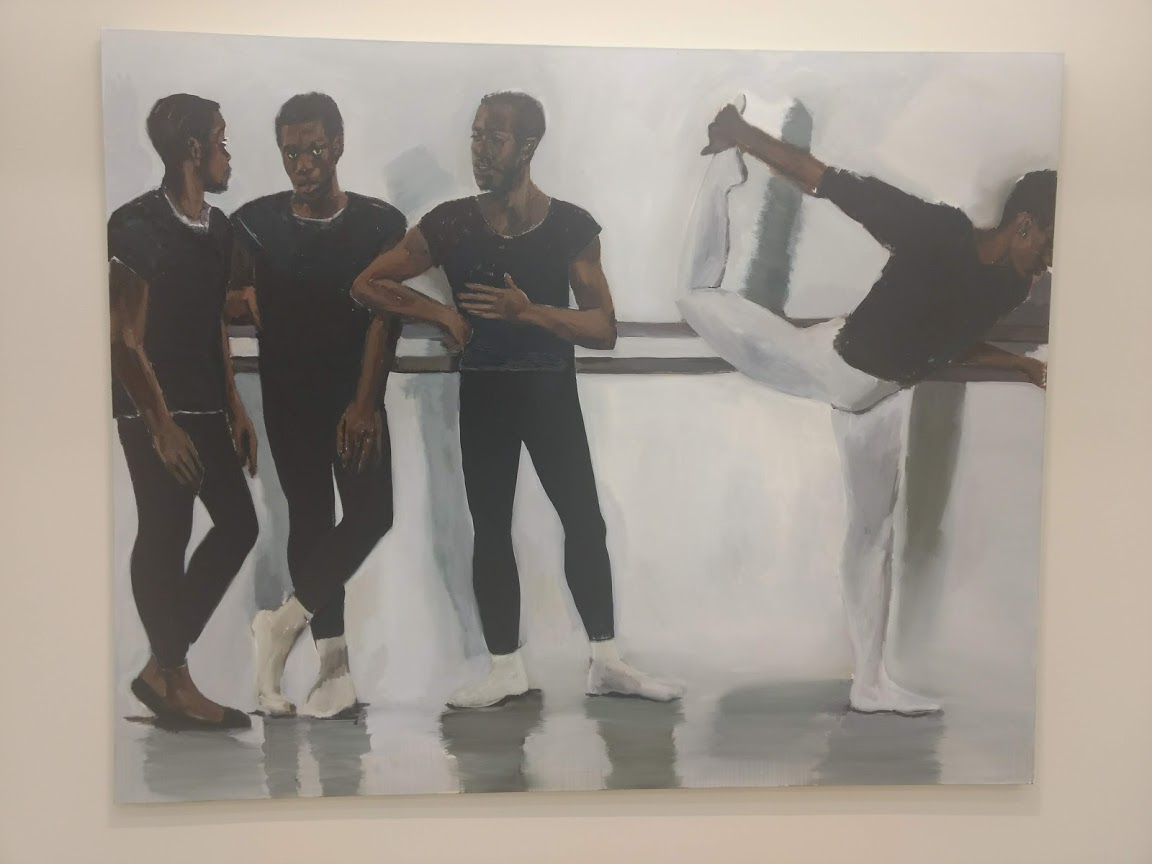
However, the grandest pleasure is four midnight blue panels —a quadtych— of dark skinned women in white leotards and hunter green tights, their arching bodies shaped like crescent moons. Three face the fourth—the fourth body facing them. Perhaps she is an instructor, guiding them into proper formation. Moreover, this series responds beautifully to a painting in the other gallery location. On a singular canvas, four male dancers are dressed in the same hunter green with one male interrupting the linear.

Yiadom-Boakye’s evocative Black figures fulfill a huge void in this post-contemporary age of painting. Their extraordinary presences are supposed to be here. The disturbing, eyebrow-raising stories found in the back pages of Yiadom-Boakye’s exhibition catalogues, however, propel the reader to reread like an avid viewer studying the intriguing contrasts in her paintings. Although Dinner With Jeffrey’s Hecuba showcases gruesomely bizarre behavior (aiding and abetting murder), she would eat her lovers’ parts with her family—ultimately devouring unworthy men in a succubus vacuum—and pine away for the fairy tale ending. In Lieu of a Louder Love is the urgent love letter that ardently confesses how much marginalized Black bodies matter to the one woman painter who would not deny us our due.

Monday, January 7, 2019

Happy Birthday Zora Neale Hurston

We celebrated Zora Neale Hurston in a most honorable way.
Last night, I discovered Our Mothers' Kitchens, an organization committed to bridging culinary and literature together while also mentoring young black girls in and out if the kitchen. Yoga teacher/herbalist/community educator Shivon Pearl Love and artist/poet/health educator Khaliah D. Pitts have created this outstanding vision:
Using the works of Vertamae Smart-Grosvernor, Ntozake Shange, Zora Neale Hurston and Alice Walker, Our Mothers’ Kitchens seeks to introduce young women of color to the ways in which these Black female authors intersect food and language as a means of liberation, expression and cultural preservation. Continuing the use of traditions from the African diaspora, where art and life are one, Our Mothers’ Kitchens takes vital steps towards building optimal health, self-awareness and cultural connection through the ritual and art of cooking and storytelling.
At Duafe Holistic Salon, Our Mothers' Kitchens hosted a special catered dinner that honored birthday girl, Zora Neale Hurston. This was the second of four in the "In Search of Our Foremothers" series (the first being Ntozake Shange R.I.P.). These authors words' are the foundations for the menu items and the parties are "thrown" on/around their birthdays.
In the Zora feast-- all plant based vegan-- the appetizer, salad, entree, dessert, and beverage specifically draw on excerpts vividly detailed in Mules and Men, Their Eyes Were Watching God, and Dust Tracks on a Road.
Guests were invited to pick selective quotes and bring an item for "Zora's Alter."

I chose a beautiful quote about writing from Zora's autobiography, Dust Tracks on a Road.

The Black Eyed Peas Collard Wrap was inspired by Zora Neale Hurston: A Life in Letters while the delicious "Homemade Cola" (made with ginger, star anise, and other spice kicks) delivered the first taste of Their Eyes Were Watching God.

"The String Beans and Potatuhs," also created with Their Eyes Were Watching God in mind, contains crisp beans and fork tender potatoes, amazing alongside the endless refills of "Homemade Cola."

Their Eyes Were Watching God then embodies the flavorful entree: a generous portion of "Mulatto Rice" and "Janie Cakes" with molasses and rosemary. The incredibly savory rice was prepared in black eyed peas stock (which I must obtain the recipe for), smoked paprika, turmeric, and other feel good ingredients. The "Janie Cakes" were light and tasty, pieces of yellow corn like surprises in every bite. 

I especially loved dessert--a moist and succulent slice of gingerbread adorned with pretty colored flowers and sugared pineapple. Definitely made me dream the way Janie dreamed. Mules and Men set the final kitchen influence of the evening.

Fashionable schoolteacher Aura (whom I sat across from) pictured with Our Mothers' Kitchens co-creator Shivon Pearl Love (on the right).

Khaliah D. Pitts, the other gracious co-hostess/co-founder, closed an intimate night with a tender poem, Zora in heart and spirit.

The Zora Library. 


I never knew a book of Zora's letters existed. It's definitely on my Books to Read 2019 Edition. 

The Zora "Altar" contained her books, a finger puppet, cowrie shells, flowers, and mugs, sacred items of the diners.
The fun, educational tribute to a humorous, talented, sassy, down-to-earth Zora provided sweet sustenance for those in attendance. We came together to read Zora aloud, blend our personal stories with hers, and discuss other great conversation points around a table, safe in body, mind, spirit.

Friday, December 28, 2018

Multiple Disciplines of the Multidisciplinary Mind

"We're Never Having This Party," acrylic on canvas, 36" x 48, 2018.
On the lovely night of December 14th, I had my first solo opening, "Let Them Eat Sweet," in Philadelphia at the B(A)LM (Black Artists Liberation Movement) Studio. Makeba Rainey, the gallery's founder and curator, had worked in the wee hours to finish painting this second space walls a rich, glorious red-- a provocative hue that added extra oomph for my paintings and drawings to live and breathe.
As we hung everything the morning of, I thought back to artist/oral historian/poet Kymberlee Norfleet's confessional installation-- the first B(A)LM exhibit. She allowed herself to be vulnerable, confront lifelong pain head on through the many objects placed in the space with great care and deliberation. Every picture, book, and candle had a reason to exist. Although physically gone and moved onto Vox Populi in another form, the fervent memories of Kymberlee's collection are still thriving, the seeds having implanted strong, valiant foundation that tells the next artist, "this moment is yours. Employ your time well."
And "Let Them Eat Sweet" now occupies that message and aims to carry it through to the artist afterward.

A whole view. The lights are white and purple.
The space operates on sensational emotions, the experience of joy and togetherness, the communal act that happens before we dine. The illustrations depict fictional encounters between lost sisters that don't necessarily close gaping wounds, but provide much needed healing under the cover of bright colors and euphoric faces. Others offer self portraitures to exist with iconic ghosts of the past whose legacies are often regarded and mimicked. After all, the sincerest form of flattery is to copy, right?

Pencil drawings grouped together.
In returning to painting, near the end of summer, I returned to a once seemingly dead purpose coming back to life. Prior, I wanted to commit, to take time and effort, but pushed creativity aside to steep in emotional drainage. Additionally, I wrote new stories about hopes, dreams, and encounters, influenced by daily life activities, by reading so much in the dark. Thus, my creativity ignited and bloomed purposely. I was more than happy to defeat depression and come back down to earth, to explore the depths of imagination and have a place to put them together. Now the desire to paint is charged up like a battery, ready and ever so willing.

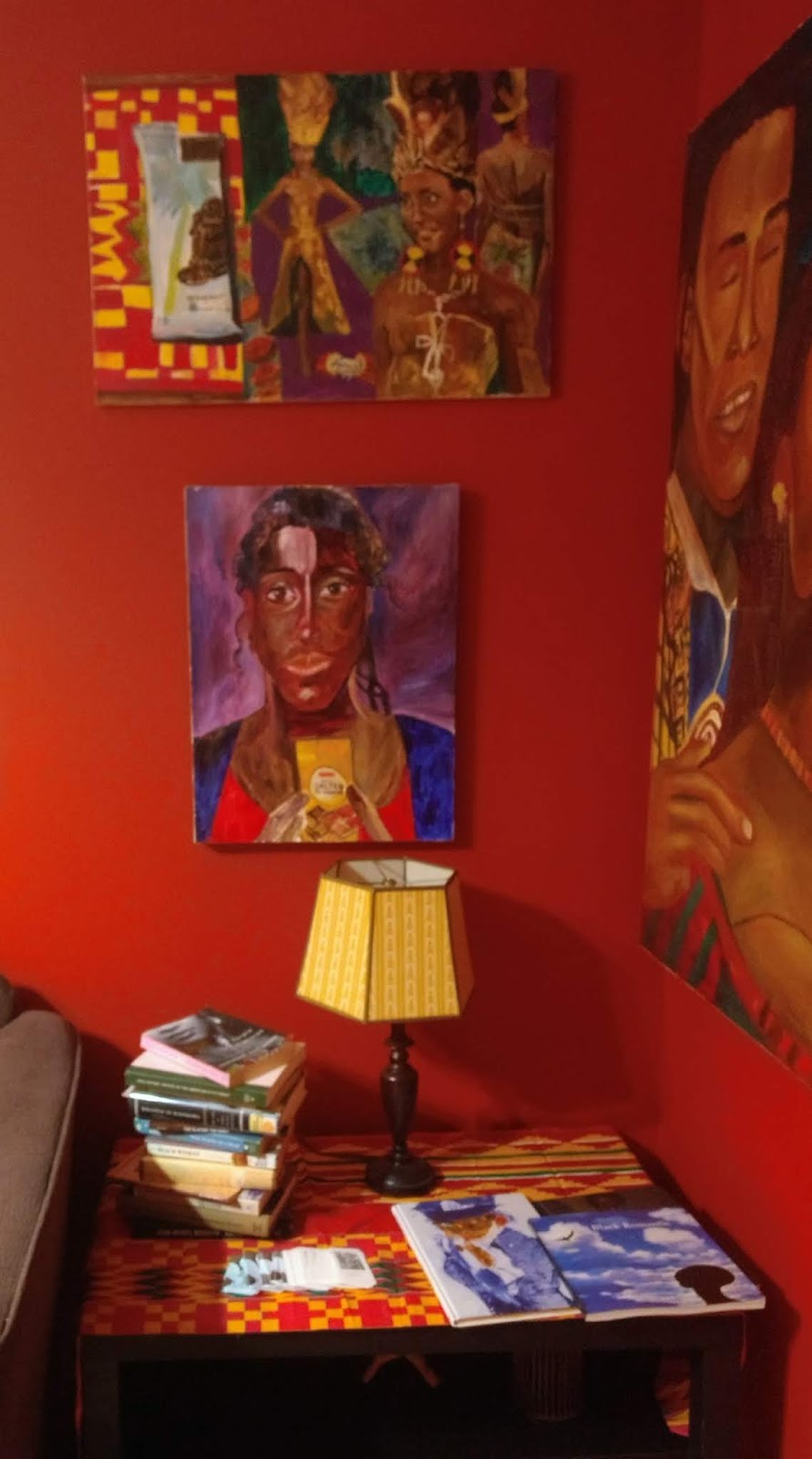
Corners that evoke stories about Grenada, romance, and fair trade chocolate. 
I incorporated literature, prose, poetry, and art books that inspired me throughout the sweet labor that is painting and drawing-- Zora Neale Hurston, Wallace Thurman, Jean Michel Basquiat, Sojournor Truth, Gwendolyn Brooks, and others. The artist as an avid reader is just as important as the role the artist has in the studio. Words shape the mind, sharpen tools, and enhance abilities. Yet reading is imperative for the artist who loves to write as well.

"Her Eyes Weren't Watching Cupcakes," acrylic on canvas, 24" x 48," 2018.

Books and business cards.
The opening itself presented the gracious opportunity to bake, to place my plant based talents on the table in juxtaposition to the works on three walls. As in the Friendsgiving and the first artist reception, sweetness was my specialty. Fair trade chocolate played a crucial role in several paintings. So I baked fudgy brownies with Divine Chocolate and Theo Chocolate-- both source their cacao from different slave free parts of the globe.

I baked brownies, cookies, and crock pot chai tea for the opening. Also on hand, crackers, grapes, Miyoko's Kitchen Sun Dried Tomato Cheese, Chuao Chocolatier Sea Salt Dark Chocolate, tortilla chips, salsa, and box red wine.

The homemade snickerdoodles came out comically large and needed to be cut in half.

After the wonderful curated playlist (which included Martina Topley-Bird and Massive Attack), we put on the Janelle Monae record to end the evening.

Thank you to my friend Ian for capturing me with Zora in front of Zora.
It is a tough road ahead post graduate life. Most people will face tons of rejection-- from exhibition opportunities, residencies, grants, etc. Nobody seems to want to talk about that path, the ugly reality of an artist's chances to survive in a gritty industry, especially those traveling alone. Yet at B(A)LM (a safe community haven for the ones who have work to urgently show and reveal), to be visible and chosen for once in my five years living isolated in Philadelphia sets a personal achievement. I can finally see that the journey ahead doesn't always have to be so lonesome.

The B(A)LM (Black Artists Liberation Movement) Studio is located in the Kensington area of Philadelphia on 2056 East Huntingdon Street, Philadelphia, PA 19125, opened Mondays and Fridays, 12pm-4pm.

Tuesday, May 22, 2018

House Of Chocolate: An All-In-One History Museum, Cafe, & Boutique

Just beside the Grenada History Museum, House of Chocolate Grenada  offers an even sweeter history lesson.
It was a fascinating touch of blissful wonder strolling through the bumbling doors of House of Chocolate-- a mini-museum space exploring history of chocolate in the heart of the Caribbean country. In addition to an informative layout on chocolate history, House of Chocolate features an indie spirited store housing chocolates, chocolate inspired books, clothing, purses/wallets, jewelry, spices, and more among a small café and homey gathering space. An on site chocolatier preps all of the yummy chocolate confections and delights. Although most desserts and drinks are nonvegan, there are exceptional treats for us including unique truffles and a sensational mug of hot cocoa tea-- a premiere specialty.

Viewers are instructed to enter and make a left towards the museum side, learning first about cacao and its three main varieties: Criollo, Forastero,and Trinitario. Criollo (means "native" in Spanish), originated in Mexico and primarily cultivated in Central America, has notes of caramel, nuts, vanilla, and tobacco, is the rarest and most expensive cocoa, and accounts for 5% of the cocoa beans grown in the world. Forastero (means "foreigner" in Spanish), originated in the Amazon and primarily cultivated in West Africa, Ivory Coast, and Ghana, has a classic mild chocolate flavor, is the most commonly grown cocoa bean, and is a fast growing, high yielding tree, very resistant to disease unlike Criollo. Trinitario is a natural hybrid of Criollo and Forastero-- results of an accidental cross-fertilization that transpired in Trinidad around 1730. It is primarily cultivated in Grenada, Venezuela, Jamaica, Trinidad and Tobago, Papua New Guinea, and other Latin and Caribbean countries. It has a high bean flavor, fragile tree, and produces a rich cocoa grade flavor.

What is cacao? Quite frankly, the heart of all chocolate dreams and desires.

The museum then centers on local history. Some of it isn't pretty.
A waxing poetic story that glaringly sugarcoats cacao bean slavery and excess colonialism complete with lithography illustrations.

Archive photo of cacao farmers.

Cacao beans were formerly used as wealth and status. In this historic pricing chart, cacao beans could get someone animals like rabbits and turtles (insert sobs), clothes, jewelry, and slaves (crying).

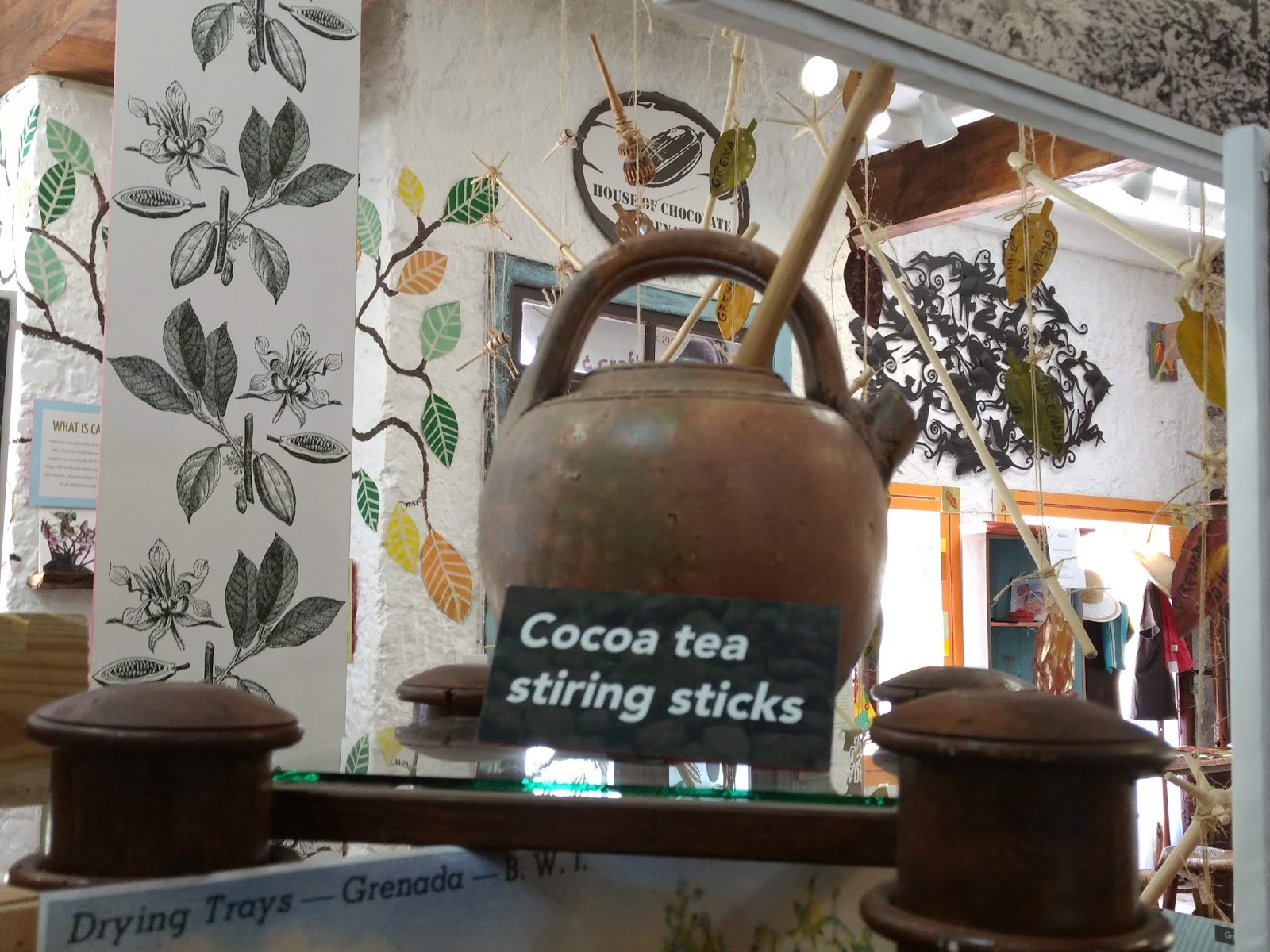
Old fashioned devices of the cocoa tea.

Visitors can peel cacao shells and grind them into paste.

Keep calm & eat Grenada Chocolate. Okay.

Chocolate scented candles galore.

From Curious George to chocolate recipes and chocolate history, there is a sweet topic for all ages to browse through in the small book collection. 

The top shelf chocolate books.

I ordered the cocoa tea, a huge treat for the locals. It is made with a cocoa ball (cacao nibs rolled up with spices and bayleaf) melting into hot water and served with organic sugar.

The hot beverage is a fine line between tea and hot chocolate, rich and delightful, sophisticated and refined.

On my birthday, almost seven years ago, the world's largest chocolate bar was made in Alfreton, Derbyshire, UK!

The only vegan treats were a top of row of truffles excluding peanut butter and salted vanilla-- strawberry, passion fruit, ginger, and guava were dairy free.

Also featured in the gift shop/boutique, expect Grenada's top chocolate companies-- Grenada Chocolate Company, Crayfish Bay, and Jouvey Chocolate.

In addition to chocolate bars, cocoa powders, cacao nibs, cocoa tea balls, and cocoa butter are some specialty treats on sale.

I tried enticing free samples of ginger, nutmeg, nibs, salted pieces-- all amazing tidbits of pure dark chocolate sweetened with sugar and spice. It was hard to pick a favorite.

I hold a cacao pod with great joy having earlier suckled a taste of an opened plant. Slick and slimy seeds are covered in white flesh. You suck off the flesh, which tastes sweet and fruity like the juice of bananas. 

Gorgeous artisan truffles in Strawberry and Passion fruit.

I came back two days later, on my last day, for another helping of cocoa tea.

Making forth a home on a comforting bench with a cacao pod pillow.

A 2lb chocolate bar would have been nice to take home-- except it was extremely hot in Grenada, too hot to lug around a bar that would melt in rapid seconds. Still, what a beautiful sight!

Well deserved trip advisor Certificate of Excellence honor for House of Grenada, an exceptional, creative environment with warm, welcoming atmosphere featuring courteous staff, delicious island made chocolate, and plentiful good reading. I hope to return again someday.